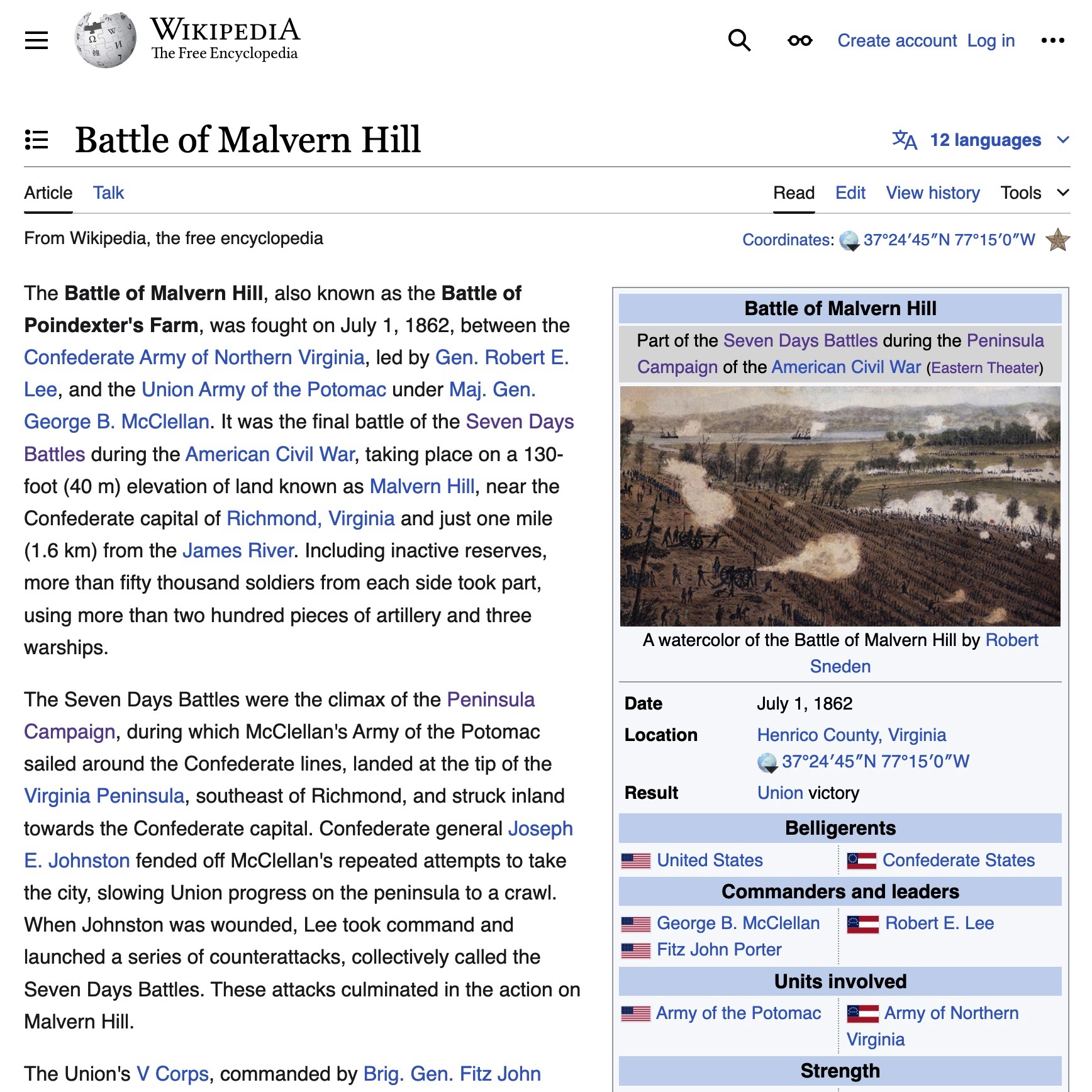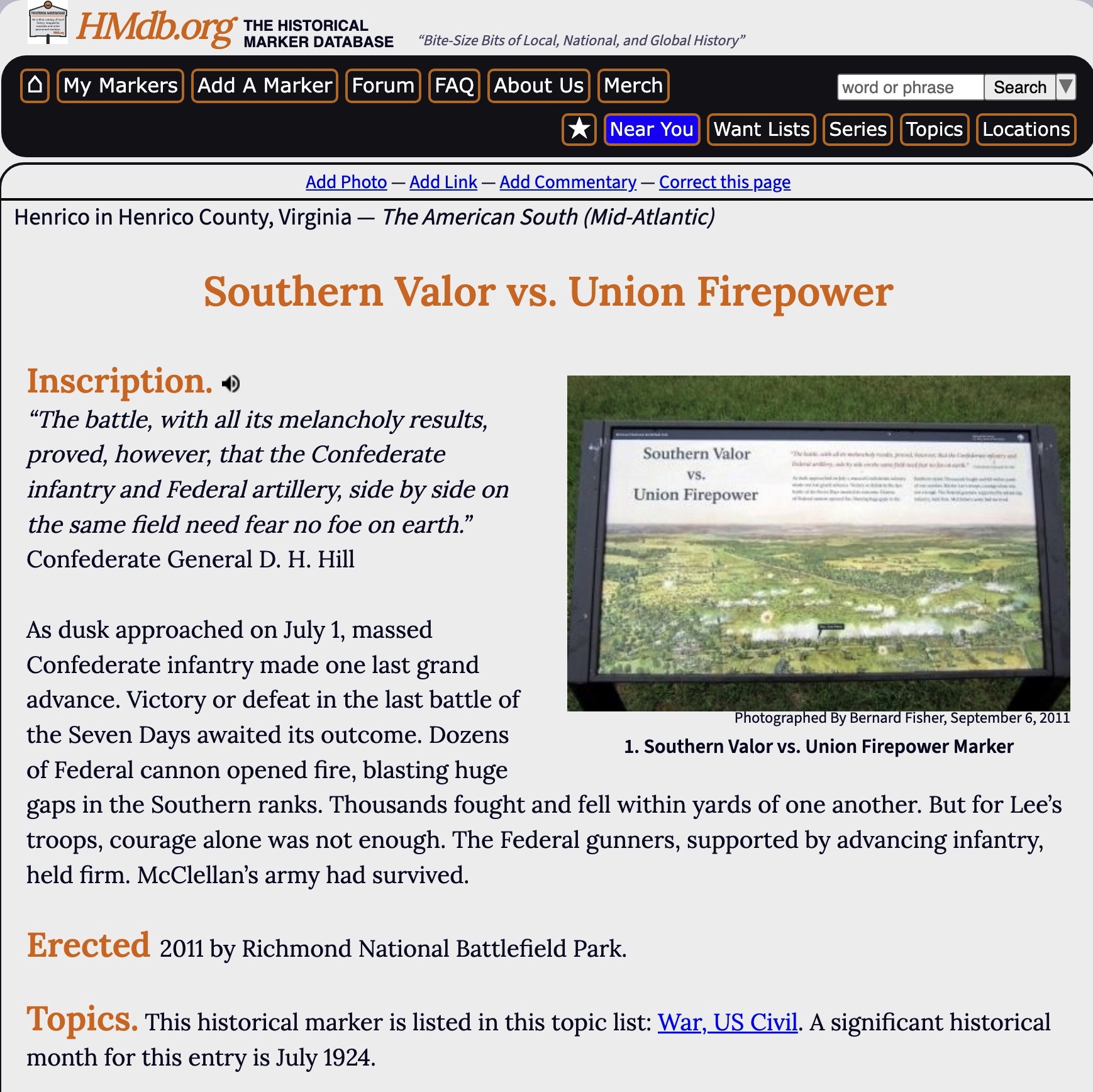
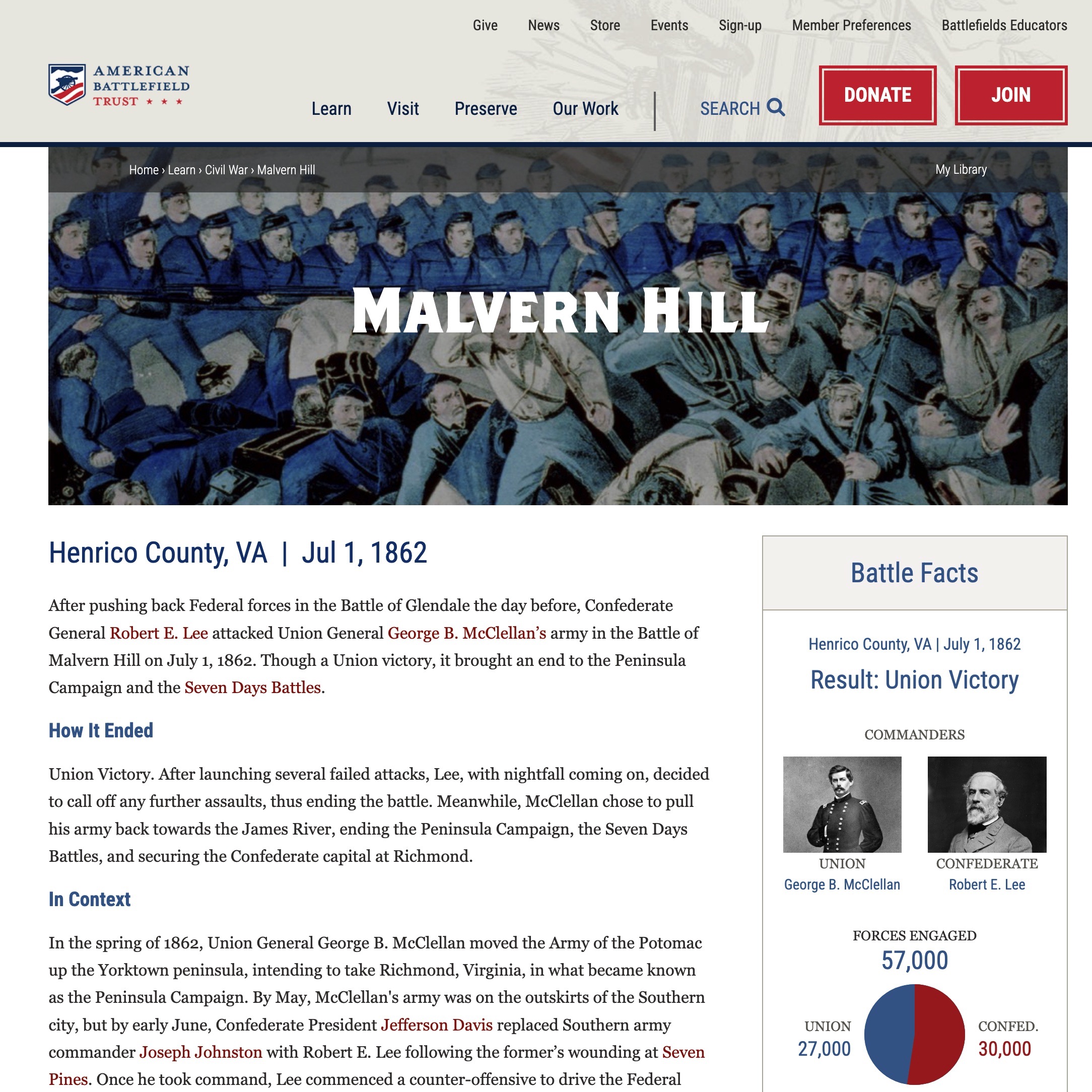
The Battle of Malvern Hill was the last of the Seven Days’ Battles.  The Seven Days’ Battles were a series of battles that took place during the summer of 1862.  The Confederates, under General Robert E. Lee, were trying to drive the Union troops, under George McClellan, away from Richmond.  It was also Lee’s hope to defeat them before they reached the protection of the gunboats waiting in the James River.  On this last day of the battle, July 1, 1862, the Union had almost retreated to the safety of the James River.  They occupied the top of a hill called Malvern Hill.  In order to attack them, the Confederates had to run uphill across an open field.  The Union cannons were able to fire at the advancing Confederates before they got close enough to fight. But a few brave Confederates avoided the explosions long enough to cause 3,214 Union casualties. Nevertheless, the Confederates suffered 5,355 casualties and lost the battle without making any gains. In the end, McClellan and his Union troops made it to the James River and sailed away.  Lee and McClellan would meet again a few months later at the Battle of Antietam in Maryland, one of the deadliest battles in American history. (Trouble viewing the YouTube video? Try Vimeo or direct link).

Did you know that the famous author, Herman Melville, wrote a poem about Malvern Hill? He actually wrote many Civil War poems, and his son, Malcolm, was a soldier in the Union army. Here is part of his poem:

Ye elms that wave on Malvern Hill

    In prime of morn and May,

Recall ye how McClellan’s men

    Here stood at bay?

While deep within yon forest dim

    Our rigid comrades lay—


This is a Google map of Malvern Hill Battlefield. Use the +/- button to zoom in or out.


This is a 360 view of Malvern Hill Battlefield. Click and drag to look around.

HC.2a The student will examine the influence of physical and cultural geography on Henrico County.

HC.2b The student will analyze, interpret, and demonstrate knowledge of significant historical events and ideas in Henrico County history.