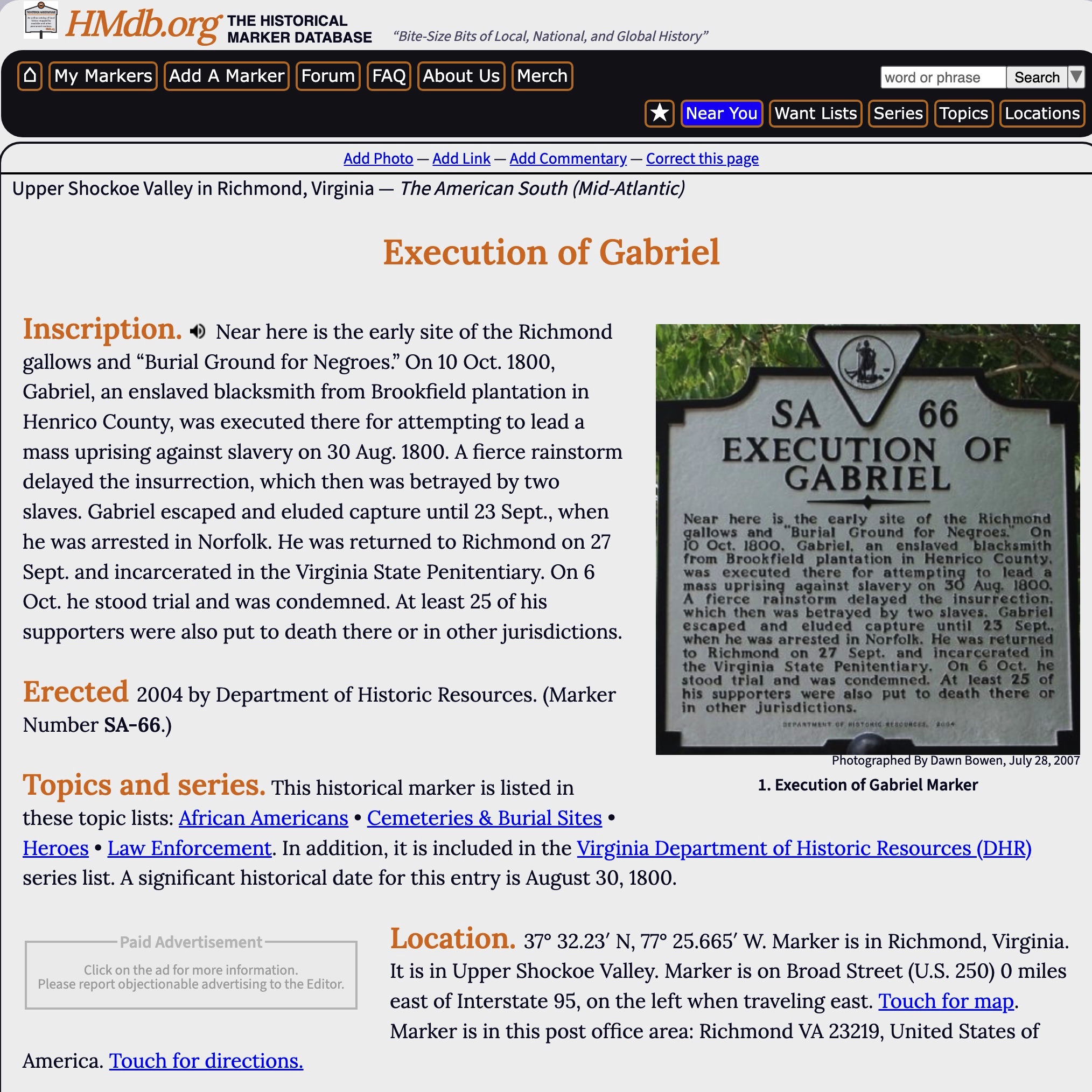
Gabriel was a slave who worked on the Brookfield tobacco plantation in Henrico County.  He was the blacksmith, which means he produced most of the metal tools used on the farm. Born in 1776, the year of America’s independence, Gabriel grew up hearing about the importance of freedom. He wanted freedom for himself and all slaves, so he started planning a huge revolt.  He recruited many others to join him and began collecting weapons.  His plan was to attack the Capitol in Richmond and take Governor James Monroe hostage (Monroe would later become the 5th president of the United States).  On the night of the revolt, Saturday August 30th, 1800 there was a terrible thunderstorm, and the rivers and roads in the area were flooded.  Gabriel had to postpone his revolt for the next day.  However, two slaves from Meadow Farm, Tom and Pharaoh, alerted the owner of the farm, Mosby Sheppard, who in turn, warned the governor of the plot.  The militia was called out and many of the slaves were captured and put to death, including Gabriel. (Trouble viewing the YouTube video? Try Vimeo or direct link).

Did you know that the two slaves from Meadow Farm, Tom and Pharoah, gained their freedom for their role in exposing the plot? You can read the actual letter from Mosby Sheppard telling about how the men knocked on his door that night to tell him about the rebellion. This is a primary source.


This is a Google map showing Brook Road, near where Gabriel lived.  Use the +/- button to zoom in or out.


This is a 360 view of Brook Road, near where Gabriel lived.  Click and drag to look around.


HC.1 The student will demonstrate responsible citizenship and develop skills for historical and geographical analysis.

HC.2a The student will examine the influence of physical and cultural geography on Henrico County.

HC.2b The student will analyze, interpret, and demonstrate knowledge of significant historical events and ideas in Henrico County history.

HC.2c The student will demonstrate an understanding of the growth of Henrico County’s economy from 1611 to present day.