


Here is a Google map of Yorktown and the York River. Use the +/- button in the bottom right to zoom in or out.
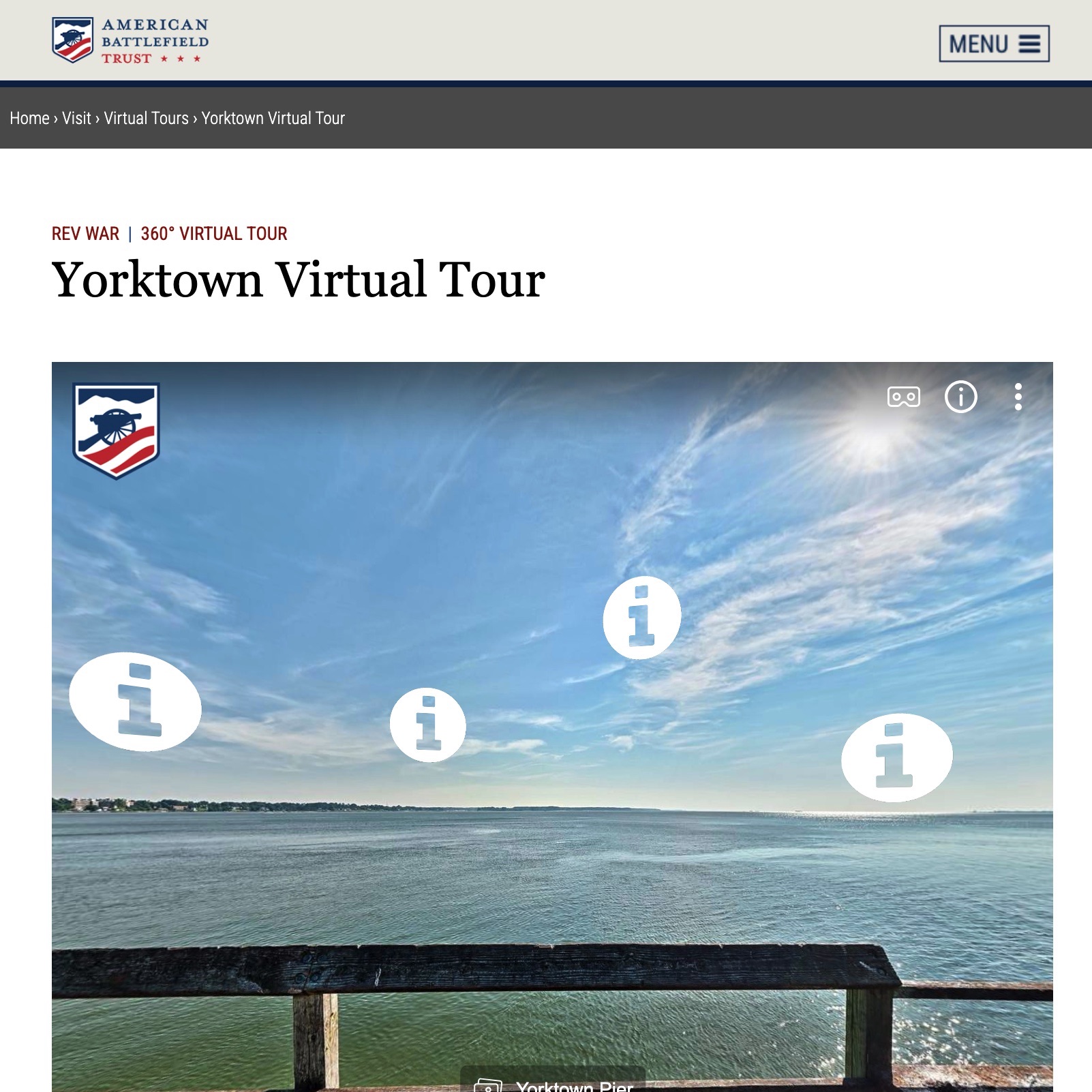
This is a 360 view of the York River. Click the arrows to look around.
This is a 360 view of the Yorktown battlefield. Click and drag to look around.



Social Studies
1.2 (2015) The student will demonstrate knowledge of Virginia history by describing important events and people in the history of the Commonwealth, including
b) famous Virginians, such as George Washington and Thomas Jefferson, who helped form a new nation;
1.5 (2023) The student will apply history and social science skills to describe contributions of Virginia’s diverse people and the stories of changemakers in the history of Virginia and their contributions to our Commonwealth, including but not limited to
c. Presidents: George Washington, Thomas Jefferson, James Madison, and James Monroe;
2.7 (2023) The student will apply history and social science skills to describe the revolutionaries who fought for America’s freedom (1764-1781), including but not limited to
h. George Washington (“Father of our Country”).
VS.2 (2015) The student will demonstrate an understanding of the relationship between physical geography and the lives of the native peoples, past and present, of Virginia by
b) locating and describing Virginia’s Coastal Plain (Tidewater), Piedmont, Blue Ridge Mountains, Valley and Ridge, and Appalachian Plateau;
c) locating and identifying water features important to the early history of Virginia (Atlantic Ocean, Chesapeake Bay, James River, York River, Potomac River, Rappahannock River, and Lake Drummond and the Dismal Swamp);
VS.5 (2015) The student will demonstrate an understanding of the role of Virginia in the American Revolution by
b) identifying the various roles of American Indians, whites, enslaved African Americans, and free African Americans in the Revolutionary War era, including George Washington, Thomas Jefferson, Patrick Henry, the Marquis de Lafayette, and James Lafayette;
c) identifying the importance of the American victory at Yorktown; and
VS.1 (2023) The student will apply history and social science skills to explain the relationship between physical geography and the lives of Virginia’s peoples, past and present by
c. locating, identifying, and describing the impact of Virginia’s bodies of water on its history, economy, and culture.
VS.5 (2023) The student will apply history and social science skills to explain Virginia and Virginians’ role during the American Revolution by
b. examining the important contributions, leadership, and experiences of Virginians during the war, including but not limited to George Washington, Thomas Jefferson, George Mason, James Madison, James Armistead Lafayette, Indigenous Peoples, women, and free and enslaved Blacks;
d. identifying the importance of the American victory at Yorktown.
USI.6 (2023) The student will apply history and social science skills to explain the American Revolution by
d. describing the leadership roles of individuals, including but not limited to George Washington, Benjamin Franklin, Thomas Jefferson, Patrick Henry, Thomas Paine, John Adams, and the Marquis de Lafayette; and
e. examining the causes, course, and consequences of key events and battles of the era.
Science
4.8 The student will investigate and understand that Virginia has important natural resources. Key resources include
a) watersheds and water;