
This is a Google map of Luray Caverns. Use the +/- buttons to zoom in and out.
This is a 360 view inside Luray Caverns. Click the arrows to explore.
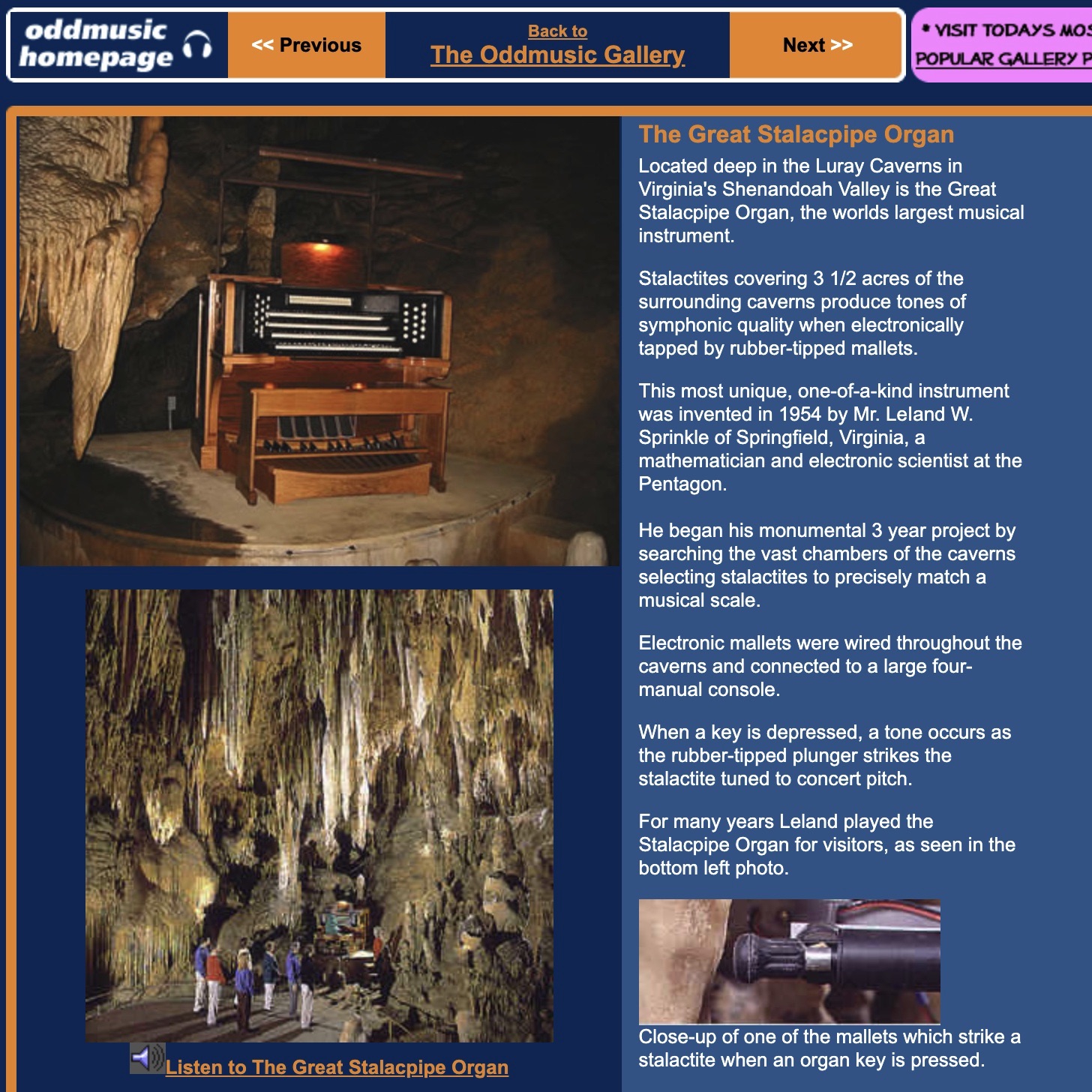
Can you find the stalacpipe organ?
Social Studies
VS.2 (2015) The student will demonstrate an understanding of the relationship between physical geography and the lives of the native peoples, past and present, of Virginia by
b) locating and describing Virginia’s Coastal Plain (Tidewater), Piedmont, Blue Ridge Mountains, Valley and Ridge, and Appalachian Plateau;
VS.1 (2023) The student will apply history and social science skills to explain the relationship between physical geography and the lives of Virginia’s peoples, past and present by
b. locating and describing the relative location and physical characteristics of Virginia's five geographic regions on a map; and
Science
5.4 The 4.3 The student will investigate and understand that organisms, including humans, interact with one another and with the nonliving components in the ecosystem. Key ideas include
a) interrelationships exist in populations, communities, and ecosystems;
b) food webs show the flow of energy within an ecosystem;
5.5 The student will investigate and understand that sound can be produced and transmitted. Key ideas include
a) sound is produced when an object or substance vibrates;
b) sound is the transfer of energy;
c) different media transmit sound differently; and
d) sound waves have many uses and applications.
5.8 The student will investigate and understand that Earth constantly changes. Key ideas include
c) the rock cycle models the transformation of rocks;
d) processes such as weathering, erosion, and deposition change the surface of the Earth; and
e) fossils and geologic patterns provide evidence of Earth’s change.