

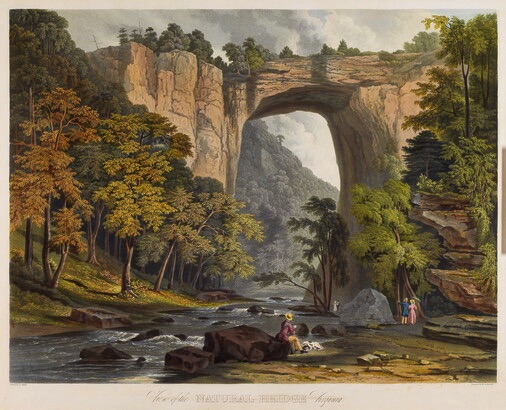
Here is a Google map of the Natural Bridge. You can zoom in and out.
This is a 360 view of the Natural Bridge. Go ahead and look around!
This is a 3-D model of the Natural Bridge. You can spin it around and zoom in.
The blue line is the Cedar Creek which flows into the James River further south.
The blue marker shows where the Natural Bridge is located.
Created with 3-D Mapper.
This is an old Flash activity about how the Natural Bridge may have formed. We got it to work using Ruffle!




Social Studies
K.4 (2023) The student will apply history and social science skills to recognize Virginia’s earliest communities by
a. identifying examples of historical events, stories, and legends;
c. recognizing that places change over time; and
1.2 (2015) The student will demonstrate knowledge of Virginia history by describing important events and people in the history of the Commonwealth, including
b) famous Virginians, such as George Washington and Thomas Jefferson, who helped form a new nation; and
c) life in Virginia today, including food, clothing, shelter, transportation, and recreation.
1.5 (2023) The student will apply history and social science skills to describe contributions of Virginia’s diverse people and the stories of changemakers in the history of Virginia and their contributions to our Commonwealth, including but not limited to
c. Presidents: George Washington, Thomas Jefferson, James Madison, and James Monroe; and
1.7 (2023) The student will apply history and social science skills to connect geography to historical events of Virginia and the United States by
a. identifying landforms and bodies of water of Virginia and describing how they affect the way people live;
2.7 (2023) The student will apply history and social science skills to describe the revolutionaries who fought for America’s freedom (1764-1781), including but not limited to
e. Thomas Jefferson;
h. George Washington (“Father of our Country”).
VS.2 (2015) The student will demonstrate an understanding of the relationship between physical geography and the lives of the native peoples, past and present, of Virginia by
b) locating and describing Virginia’s Coastal Plain (Tidewater), Piedmont, Blue Ridge Mountains, Valley and Ridge, and Appalachian Plateau;
VS.1 (2023) The student will apply history and social science skills to explain the relationship between physical geography and the lives of Virginia’s peoples, past and present by
b. locating and describing the relative location and physical characteristics of Virginia's five geographic regions on a map; and
c. locating, identifying, and describing the impact of Virginia’s bodies of water on its history, economy, and culture.
Science
5.4 The student will investigate and understand that electricity is transmitted and used
in daily life. Key ideas include
a) electricity flows easily through conductors but not insulators;
b) electricity flows through closed circuits;
5.8 The student will investigate and understand that Earth constantly changes. Key ideas include
d) processes such as weathering, erosion, and deposition change the surface of the Earth;